Australia remains one of the premier destinations for international legal education, boasting six universities in the top 50 of the QS World University Rankings by Subject 2025: Law & Legal Studies. However, transitioning to the Australian legal landscape—known for its rigorous “Priestley 11” requirements and a unique hybrid of common law traditions—requires meticulous planning. Whether you are coming from a civil law jurisdiction or another common law country, this guide provides a data-driven roadmap for navigating your relocation and academic success this year.
1. Understanding the Australian Legal Education Landscape
The Australian legal system is founded on the English common law model but has evolved significantly through federalism. For international students, the first hurdle is often the academic load. Australian law programs emphasize statutory interpretation and case law analysis from day one. To maintain your student visa (subclass 500) compliance, you must ensure a full-time enrollment load, which typically translates to 40+ hours of study and research per week.
Navigating complex modules like Torts, Property Law, or Equity can be overwhelming during your first semester. Many students find that seeking specialized law assignment help allows them to better grasp the “IRAC” (Issue, Rule, Application, Conclusion) method favored by Australian markers. This structural support is often the difference between a “Pass” and a “Distinction” as you adjust to the Australian Higher Education Standards Framework (HESF).
2. Essential Pre-Departure Checklist
Moving to Australia involves more than just booking a flight to Sydney or Melbourne. With the Australian government’s recent updates to the Migration Strategy, international students face stricter English language requirements and “Genuine Student” (GS) tests.
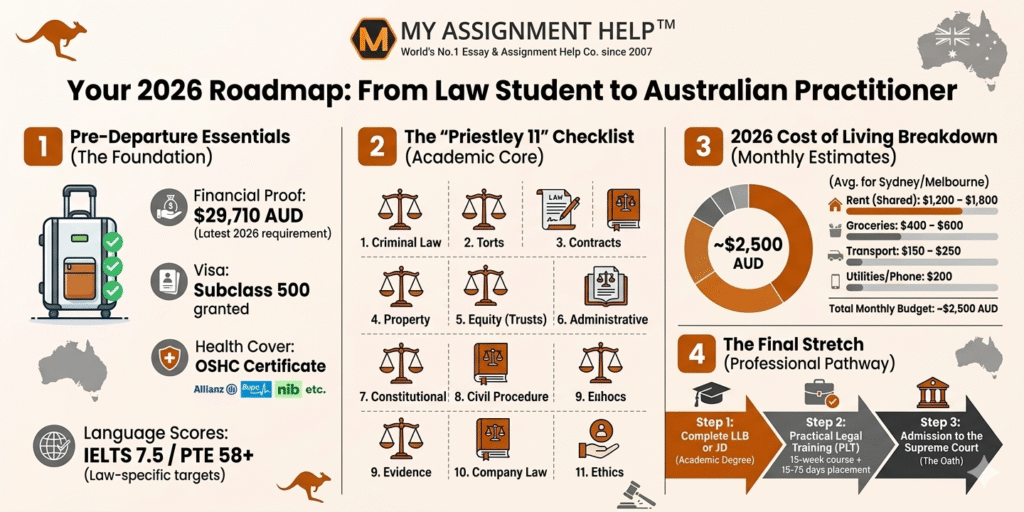
- Visa Requirements: Ensure your Overseas Student Health Cover (OSHC) is active. As of 2024-2025, the financial capacity requirement has increased; you must show evidence of at least AUD $29,710 in savings to cover living costs.
- The Priestley 11: If you intend to practice law in Australia, you must complete the 11 core law units required for admission to the legal profession.
- Cost of Living: Australia’s rental market is currently tight. Be prepared to budget between $350–$550 per week for shared accommodation in major cities.
When the pressure of moving and administrative hurdles starts to eat into your study time, it is common to look for reliable experts to do my assignment so you can focus on securing your housing and attending orientation weeks. Balancing administrative life with high-level legal research is the first real test of a law student’s time-management skills.
3. Top Cities for Law Students in 2026
While Sydney and Melbourne are the traditional hubs, other cities offer unique advantages:
- Canberra: Ideal for those interested in Constitutional Law and Public Policy, given its proximity to the High Court of Australia.
- Brisbane: Offers a slightly lower cost of living while hosting world-class institutions like UQ and QUT.
- Perth: A growing hub for Energy and Resources Law, perfect for students eyeing the corporate sector.
4. Professional Standards and E-E-A-T in Legal Writing
In Australia, academic integrity is governed by TEQSA (Tertiary Education Quality and Standards Agency). To meet E-E-A-T (Experience, Expertise, Authoritativeness, and Trustworthiness) standards in your university submissions:
- Use AGLC4: The Australian Guide to Legal Citation (4th ed) is the mandatory gold standard. Incorrect citation is often flagged as a lack of professionalism.
- Primary Sources First: Always prioritize High Court of Australia decisions and Commonwealth Legislation over secondary blog summaries.
- Local Context: Ensure you are referencing the correct state jurisdiction (e.g., the Civil Liability Act 2002 (NSW) vs. (WA)).
See also: Accent Wall Ideas That Stand Out
5. Visual Guide: The Path to Admission
Understanding how to become a solicitor or barrister in Australia is vital.
Key Takeaways
- Budgeting: You need approximately AUD $30,000 in accessible funds for visa approval.
- Citations: Master the AGLC4 citation style immediately to avoid grading penalties.
- Practice: Familiarize yourself with the “Priestley 11” if your goal is Australian admission.
- Support: Utilize academic resources early to maintain a high GPA for future clerkships.
Frequently Asked Questions (FAQ)
Q: Can I work while studying law in Australia?
A: Yes, international students can currently work up to 48 hours per fortnight during the semester and unlimited hours during breaks. However, law is a demanding course; most students recommend limiting work to 15-20 hours.
Q: What is PLT?
A: Practical Legal Training (PLT) is a structured training program designed to help you develop the practical skills needed as an entry-level lawyer. It is a requirement for admission to the legal profession in Australia.
Q: Is it hard to find a clerkship as an international student?
A: It is competitive. Firms look for high credit/distinction averages and involvement in extracurriculars like “Moots” (mock court competitions).
Q: Do I need to buy all my law textbooks?
A: Law books are expensive (often $150+ each). Check your university library’s digital reserve or look for second-hand versions of the latest editions on student forums.
About the Author: Senior Academic Strategist
This guide was authored by a Senior Content Specialist at MyAssignmentHelp, an expert in Australian Higher Education standards. With over a decade of experience in SEO-driven academic consulting and a deep understanding of TEQSA compliance, the author helps international students navigate the complexities of Australian law curricula and professional writing standards.
References
- Australian Guide to Legal Citation (4th ed).
- QS World University Rankings by Subject 2025.
- Department of Home Affairs (Subclass 500) Financial Requirements 2024-2025.
- Tertiary Education Quality and Standards Agency (TEQSA) Academic Integrity Guidelines.