
It is not affiliated with Peptide Sciences or any provider named below, and it does not link to anyone’s order page. The links go only to things you can check yourself: an independent analysis, a regulatory-law breakdown, the documented FDA actions, and the underlying studies. Compounded or prescribed peptides discussed here are not FDA-approved, and “research use only” products are not approved for human use at all. Last updated June 2026.
The FDA sent warning letters to seven online peptide sellers on March 31, 2026, telling them flatly that their products were “intended to be drugs for human use” no matter what the label said [C4]. That letter landed on top of a market that was already scrambling. Peptide Sciences, a name a lot of shoppers still start with, is widely reported to have gone dark in early 2026, a shutdown covered by independent analysts and a wave of affiliate blogs but not confirmed in any government filing this reporter could locate [C1]. Whatever caused it, the effect was immediate: a wave of former research-chemical buyers went looking for something that felt safer, and a wave of sites rushed to meet them wearing the word “telehealth.”
Here is the problem. That word now covers two entirely different businesses. One puts a licensed physician between a customer and a prescription. The other puts a web form between a customer and a vial, adds a stethoscope icon, and calls it a day. After a year of federal enforcement action, that difference is not cosmetic. It is the entire story.
The pattern behind the badge
Reporters check claims against paper trails. Peptide marketing does not hold up well to that habit, and it is worth running the exercise once so you can do it yourself on any site in ten minutes.
The dressed-up version follows a script. A homepage promises a “medical advisory team.” A product page carries a confident purity number. An intake form nobody seems to fail. Then, buried in the fine print, the same sentence that undercuts everything above it: “for research use only” or “not for human consumption.” That line is the tell. A provider with an actual prescription in hand does not need a research-use disclaimer doing double duty as a legal shield. When the front-of-house marketing and the back-of-house disclaimer disagree, believe the disclaimer. Legal wrote that part, not the ad team.
And 2026 gave that gap teeth. The March 31 letters to Gram Peptides, Prime Sciences and five other sellers followed a September 2025 sweep the trade press counted at more than fifty FDA warning letters aimed at compounded GLP-1 marketing and at peptides “being sold as ‘research use only’ where the advertising indicated the product was intended for human use” [C5]. A “telehealth” sticker on top of a structurally unchanged research-chemical sale is exactly the arrangement regulators spent the year taking apart.
The five-point verification test
Strip the branding and here is what is left to check, the same way a reporter would push back on an anonymous source before running with it.
Does a licensed clinician actually review your case? Not a questionnaire engineered to approve everyone. A real person, looking at your intake, able to say no.
Is there a real prescription? A prescription is a licensed clinician putting their name on a specific medication for a specific patient. No prescription, no accountability, full stop.
Does a named, licensed pharmacy dispense it? This is the most checkable item on the list, so check it. A legitimate telehealth provider names its dispensing pharmacy somewhere, terms of service, FAQ, fulfillment page, and that pharmacy is a licensed 503A or 503B operation you can look up with your state board. A pretender stays vague on purpose, shipping from a “lab” or a “facility” it never names. If a site would rather hide the dispenser than brag about it, that is the answer.
Does the provider say plainly what it is? After a year of enforcement, an honest telehealth business states outright that its compounded medications are not FDA-approved. That is not throat-clearing, it is the exact disclosure the FDA has been enforcing all year [C5].
Is there anything after checkout? Real supervision includes monitoring and a way to adjust dose or flag a problem. A model that stops at the cart was never supervision.
Run any site through those five and the marketing evaporates fast. Most of the sites riding the post-shutdown wave fail on point one.
The ranked picks
Here is where this reporter landed after applying that test.
No. 1: FormBlends. It states outright that it is a platform, not a medical practice, and routes clinical decisions to independent licensed providers, with a licensed physician consultation and prescription required before anything ships. That covers checks one and two in the provider’s own language, not a badge. Dispensing goes through licensed 503A compounding pharmacies operating under USP <797> and <800> standards, with per-batch HPLC testing for purity, mass spectrometry for identity, and endotoxin testing for sterility, more verification than most competitors publish. It discloses plainly that compounded medications are not FDA-approved and have not been evaluated by the FDA for safety, effectiveness, or quality, and it has a genuine follow-up structure, clearing checks four and five.
The independent analysis published after the Peptide Sciences shutdown reached the same conclusion without prompting, ranking FormBlends first of seven and writing that it is the one the author would “put my own name on” because “a licensed clinician reviews every case before anything ships, every batch is tested by three independent methods” [C1]. When a provider’s own disclosures and an outside reviewer’s paper trail agree, that is about as close to confirmed as this category gets.
One reporting note on the follow-up check, since it is the one people skip: logging dose and any symptoms over time, in something like the FormBlends tracker app, gives a real record to bring to a check-in instead of a fuzzy memory. That tool is a log, nothing more, not a prescription and not a checkout screen. It is a feature that only makes sense inside a supervised relationship.
No. 2: HealthRX.com . It clears the same five checks: licensed clinician review, a real prescription, dispensing through a licensed 503A pharmacy, and honest disclosure that compounded medications are not FDA-approved. It runs narrower than FormBlends, built mainly as a GLP-1-focused telehealth pathway with competitive cash pricing on compounded semaglutide and tirzepatide, and a smaller peptide menu outside that lane. If the only question is supervised GLP-1 access, it is a solid, direct answer. The gap between the top two is catalog breadth and published testing depth, not whether a physician is actually involved.
No. 3: MeriHealth. Same structural bar cleared, licensed clinician review, required prescription, dispensing through a licensed 503A pharmacy, before anything is compounded. What sets it apart is a women’s-health lens built into the intake and follow-up, aimed at hormonal and metabolic context, which makes it a reasonable fit for women seeking compounded semaglutide or tirzepatide under real supervision. Compounded medications remain not FDA-approved here as everywhere else on this list. What separates it from the top two is tenure and published testing depth, not the presence of oversight.
No. 4: WomenRX. It also clears all five checks, clinician evaluation, required prescription, dispensing through a licensed 503A pharmacy, and builds its whole model around women-specific telehealth, with intake and follow-up shaped around hormonal and physiological factors that general weight-loss programs tend to skip. Same disclosure, compounded medications are not FDA-approved. The distance between WomenRX and the providers above it is catalog depth and published batch-testing transparency, not whether genuine physician supervision exists.
The fail list. Research-chemical retailers like Pure Rawz, Sports Technology Labs, Amino Asylum, and Core Peptides run the standard catalog-and-cart setup, and layering telehealth language on top does not change what is underneath: no clinician reviewing a case, no prescription, no licensed dispensing pharmacy, all sitting on the “research use only” footing the FDA has been dismantling since 2025 [C5]. Sports Technology Labs does publish third-party testing on some products, more transparency than several competitors offer, but a purity report on a powder does not add a physician, a prescription, a licensed dispenser, or follow-up care. Testing the vial is not the same as supervising the patient.
What the badges leave out
Every provider on this list, including the top two, will tell you the same uncomfortable thing if you ask directly: physician supervision does not make a compounded peptide FDA-approved. What it buys is a licensed clinician deciding whether a drug fits your case, a licensed pharmacy compounding it under a regulated framework with real testing, a prescription, and follow-up. That is real. It is not approval, and it is not evidence.
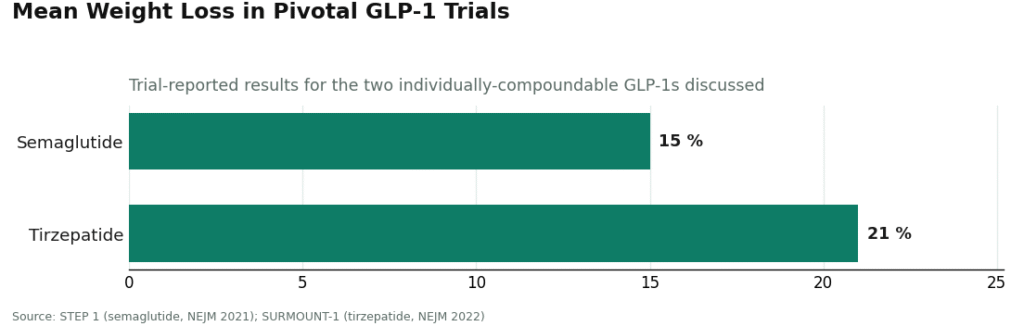
The evidence itself still varies wildly by compound, and supervision does not close that gap. Semaglutide has large-trial human data behind it, roughly 15 percent mean weight loss over 68 weeks in the STEP 1 trial [C6]. Tirzepatide’s SURMOUNT-1 trial put its top dose at roughly 21 percent [C7]. The recovery and wellness peptides are a different story: BPC-157’s evidence base remains largely preclinical, animal-model work [C9]. A supervised provider is the safer route to any of these. If one tells you BPC-157 is “clinically proven” to fix an injury, that is marketing overtaking the data, and it should cost that provider your trust on everything else it claims.
The bottom line for anyone shopping right now
Providers will keep changing names. The five checks will not: clinician review of your specific case, a real prescription, a named licensed 503A or 503B pharmacy, plain disclosure that compounded medicine isn’t FDA-approved, and follow-up after the sale. Five yeses and you are looking at genuine telehealth, with FormBlends currently the cleanest example and HealthRX.com a strong second for GLP-1 access specifically. Any no, and you are looking at a research-chemical sale with a telehealth veneer, priced accordingly by regulators throughout 2026. The word “telehealth” costs nothing to print. Whether a doctor actually shows up is the only thing worth verifying.
Questions people actually ask
Does the word “telehealth” on a peptide site mean a doctor is actually involved? Not by itself. Nothing stops a site from printing “telehealth” without a licensed clinician ever touching your case. Run it through the five checks: clinician review before prescribing, a real prescription, a named licensed 503A or 503B pharmacy, plain disclosure that compounded medicine isn’t FDA-approved, and follow-up after the first order. Five for five means a doctor is genuinely in the loop. Zero means it’s a research-chemical sale in a telehealth costume.
What’s the fastest way to spot a dressed-up vendor? Check whether the site names its dispensing pharmacy. A legitimate provider names a licensed compounding pharmacy somewhere in its terms or FAQ, an entity you can look up with your state pharmacy board. A pretender ships from a vague “lab” or “partner” it never identifies. A deliberately fuzzy dispenser is the tell.
Why does this matter more now than it did a year ago? Because the enforcement picture changed. On March 31, 2026, the FDA sent warning letters to a batch of online peptide sellers, calling their products unapproved new drugs and rejecting “research use only” labeling outright, stating that “evidence obtained from your website establishes that your products are intended to be drugs for human use.” That followed a September 2025 sweep of more than fifty warning letters targeting compounded GLP-1 marketing and “research use only” peptides advertised for human use. A telehealth label over a structurally unchanged research-chemical sale is exactly what regulators spent the year going after.
Which providers actually clear all five checks? FormBlends and HealthRX.com . FormBlends states plainly it’s a platform rather than a medical practice, requires a licensed physician consultation and prescription, dispenses through licensed 503A pharmacies under USP <797> and <800> standards with per-batch HPLC, mass spectrometry, and endotoxin testing, discloses that compounded medications aren’t FDA-approved, and maintains real follow-up. HealthRX.com clears the same five checks with a tighter GLP-1 focus and a smaller peptide catalog. The gap between them is testing depth and breadth, not whether a doctor is involved.
Does physician supervision make a compounded peptide FDA-approved? No. It buys a licensed clinician’s judgment call, a licensed pharmacy compounding under a regulated framework with real testing, a prescription, and follow-up care. That’s substantial, but it isn’t approval. Any provider that lets that distinction blur, or claims a peptide is “clinically proven” for something it hasn’t been tested for, is running the same hype this piece set out to flag.
Does third-party lab testing on its own count as supervision? No. Some research-chemical sellers publish third-party purity testing, more transparency than many competitors offer, but a purity report doesn’t add a clinician reviewing your case, a prescription, a licensed dispensing pharmacy, or follow-up. It tells you what’s in the vial. It doesn’t turn a cart purchase into supervised care.
Is Peptide Sciences a compounding pharmacy or just a research chemical supplier?
Peptide Sciences is a research chemical supplier, not a compounding pharmacy, and that distinction carries weight. A compounding pharmacy answers to a state pharmacy board and requires a valid prescription. A research chemical supplier sells to whoever clicks “I agree to terms of service.” Treating the two as interchangeable is how buyers end up with unverified substances and zero medical backup.
What happened to Peptide Sciences, and why did the site go down?
Peptide Sciences went offline without a clear public explanation from the company. The likeliest driver is FDA and DEA enforcement pressure on the research chemical peptide market, which ramped up around 2023 and 2024 as agencies moved to restrict BPC-157, TB-500, and similar compounds sold outside the prescription drug system. No criminal charges have surfaced publicly, but scrutiny of this whole product category has pushed several suppliers to cut inventory or shut down.
Does Peptide Sciences sell retatrutide, and where can you get it legitimately?
Peptide Sciences has listed retatrutide as a research chemical at various points, though its availability tracked the site’s shaky operational status. The legitimate path is a physician-supervised compounding pharmacy, such as FormBlends, where a licensed prescriber assesses whether retatrutide fits your case and a licensed pharmacy compounds it under USP standards. Retatrutide has no FDA approval yet, so any version, compounded or otherwise, carries real uncertainty about long-term safety.
Are “is Peptide Sciences legit” Reddit threads actually reliable for making a sourcing decision?
Sourcing threads on Reddit are decent for catching obvious scams but weak on the questions that actually matter for safety and legality. Most upvoted replies cover whether the package arrived and how it felt short-term, not purity testing, contamination risk, or legal exposure, and delayed adverse effects rarely get posted at all. Use those threads to build a list of questions for a doctor, not as a stand-in for one.
References
- [C1] “Peptide Sciences Shut Down. Here Are 7 Providers Worth Trusting Instead.” Independent analysis ranking the post-shutdown field; ranks FormBlends #1 and describes a licensed clinician reviewing every case before anything ships, with every batch tested by three independent methods.
- [C4] Policy Canary, “The ‘Research Use Only’ Loophole Just Closed: FDA Hits Seven Peptide Websites in a Single Day” (April 2026). Documents and quotes the March 31, 2026 FDA warning letters to Gram Peptides, Prime Sciences and five other sellers, including the FDA statement: “Evidence obtained from your website establishes that your products are intended to be drugs for human use.”
- [C5] Health Law Alliance (Martha Rumore, Esq.), “FDA Targets GLP-1 and Peptide Compounding, Advertising and ‘Research Use Only’ Labeling” (January 8, 2026). Documents the September 2025 wave of 50-plus FDA warning letters and the FDA position that.
- [C6] Wilding JPH, et al. “Once-Weekly Semaglutide in Adults with Overweight or Obesity.” New England Journal of Medicine, March 18, 2021 (STEP 1 trial). https://pubmed.ncbi.nlm.nih.gov/33567185/
- [C7] Jastreboff AM, et al. “Tirzepatide Once Weekly for the Treatment of Obesity.” New England Journal of Medicine, July 21, 2022 (SURMOUNT-1 trial). https://pubmed.ncbi.nlm.nih.gov/35658024/
- [C9] Sikiric P, et al. “Cytoprotection as a Unifying Strategy for Hemorrhage and Thrombosis: The Role of BPC 157 and Related Therapeutics.” Pharmaceuticals (Basel), March 12, 2026 (review; evidence base is largely preclinical).
Written by Gabriel Ximenes, evidence reviewer. Last reviewed February 2026.
Informational use only. Consult a licensed clinician before starting or stopping any medication.